



Walk into any academy and you'll meet someone whose supplement shelf looks like a pharmacy. Most of it does nothing. But a short list of vitamins and minerals earns its place for combat athletes, mainly because hard training, heavy sweating, and weight cuts drain your stores faster than normal life ever would.
Here's that short list, what each one actually does, and what you can skip without losing sleep.
Why combat athletes run low in the first place
Three things separate grapplers and fighters from the average gym member. Training volume, for one. Ten or more hard sessions a week is common in fight camp, and micronutrient turnover scales with workload. Then there's sweat. A hot mat room can pull liters of fluid out of you in a single session, and minerals leave with it. Finally, weight cuts. When you're eating 1,800 calories a day to make a division, you're almost certainly not covering your micronutrient needs from food alone. Restricted eating is the fastest road to deficiency there is.
None of that means you need twenty pills a day. It means the basics matter more for you than for most people.
Vitamin D3 tops the list for combat athletes
If you only fix one thing, fix this one. Vitamin D supports bone density, muscle function, immune health, and testosterone production, and grapplers are a high-risk group for running low. Think about it. Mats are indoors. You train at night or early morning, you work inside, and if you're cutting weight you're probably not eating many D-rich foods either. Research on indoor athletes consistently finds a large share with low vitamin D status, and low levels are linked to stress fractures and slower recovery.
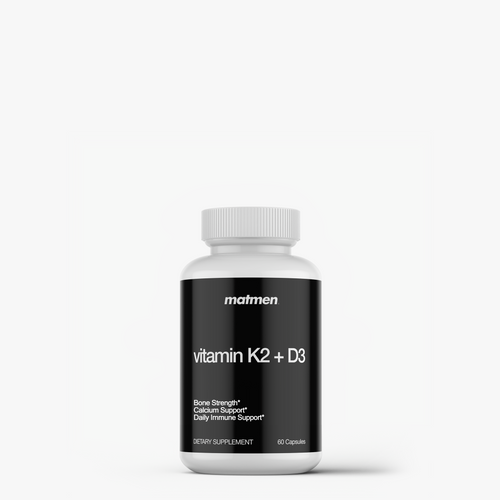
D3 is the form your body makes from sunlight and the one worth supplementing. It pairs naturally with vitamin K2, which helps direct the calcium that D3 absorbs toward your bones instead of your soft tissue. That's the logic behind combining them in one capsule, which is exactly what our Vitamin K2+D3 does. Take it with a meal that contains some fat, since both are fat-soluble.
The B vitamins keep the engine running
B vitamins sit in the middle of energy metabolism, red blood cell production, and nervous system function. If your diet is built on meat, eggs, and whole foods, you're likely covered. Two situations change that. Athletes who eat mostly plants should watch B12, since it comes almost entirely from animal foods. And anyone deep in a weight cut, eating small and repetitive meals, can drift low across the whole B group. A basic B complex is cheap insurance in those windows. Outside them, food does the job.
Vitamin C helps, but not the way people think
Hard training temporarily suppresses your immune system, which is why so many people get sick the week after a tournament. Vitamin C supports normal immune function, and being deficient is clearly bad. Megadosing, though, doesn't do much that a normal intake doesn't. There's even some evidence that very high doses of antioxidants can blunt training adaptations. Eat fruit and vegetables daily and you're done. Save your money for things that actually help.
Minerals matter just as much as vitamins
Strictly speaking these aren't vitamins, but no honest micronutrient list for fighters can leave them out.
Magnesium comes first. You lose it through sweat, it's involved in muscle contraction and sleep quality, and low levels show up as cramps, twitches, and restless nights. Glycinate is the form that's gentle on the stomach and well absorbed, which is why we use it in our Magnesium Glycinate. We covered dosing and timing in detail in our earlier post on magnesium for grapplers if you want to go deeper.
Zinc also leaves through sweat and supports immune function and hormone production. Iron matters most for female athletes and anyone training at altitude, but don't supplement iron blind. It's one of the few minerals where too much causes real harm, so test first.
Omega-3s round out the stack
Also not a vitamin, but if you're building a foundation it belongs here. The EPA and DHA in fish oil support joint health, cardiovascular function, and the resolution of inflammation after hard sessions. Grapplers put unusual stress on fingers, knees, and shoulders, and most Western diets are short on oily fish. If you eat salmon or sardines a few times a week, great. If not, a daily fish oil closes the gap.
Food first, then fill the gaps
Supplements fix deficiencies. They don't stack extra performance on top of an already complete diet, and no capsule outworks a plate of real food. So the order of operations is simple. Eat enough, eat varied, get blood work once a year if you compete seriously, and supplement the things you're actually low on or can't reliably get. For most combat athletes that ends up being vitamin D3 with K2, magnesium, and omega-3s, with B vitamins and zinc situational around weight cuts.
Get those right and you've handled the part of recovery most people ignore. The rest is sleep, food, and smart training, which we broke down in our guide to recovering faster after BJJ.
This article is for informational purposes only and is not medical advice. Talk to your doctor before starting any new supplement.