



You rolled hard Saturday morning. Now it's Monday and your lats bark every time you reach for the top shelf. Getting out of the car feels like a technique. Every grappler knows this feeling, and most of us have wondered the same thing. Is this normal, can I train through it, and is there anything that actually makes it go away faster?
Short answer. It's normal, you usually can, and yes, a few things help. But most of what gets sold as a soreness cure does nothing. Here's how to sort it out.
What muscle soreness after BJJ actually is
The soreness that shows up a day or two after training is called delayed onset muscle soreness, or DOMS. It's not lactic acid. That old story refuses to die, but lactate clears out of your muscles within an hour or so of training. DOMS is microscopic damage to muscle fibers and the inflammation that follows while your body repairs them.
That repair process is the point. Your body patches the fibers back stronger than before, which is a big part of how you adapt to training. So the goal isn't to eliminate soreness completely. The goal is to keep it from wrecking your week so you can get back on the mats.
One useful detail. DOMS is driven mostly by eccentric contractions, where the muscle lengthens under load. Think about resisting a guard pass while somebody's full weight drives through you, or fighting grips while your arm gets straightened out. Grappling is packed with exactly this kind of contraction.
Why grappling leaves you more wrecked than the weight room
Lifters get sore in the muscles they trained. Grapplers get sore everywhere, because rolling is unpredictable. You're producing force in positions you didn't choose, at angles no machine would ever put you in. Your neck, your grips, the deep muscles along your spine, the little stabilizers in your hips. None of that gets trained evenly, and all of it takes damage when you roll hard.
Add the isometric work of holding positions, the breathing load of a hard round, and the fact that most of us roll multiple rounds against fresh partners, and it makes sense that a Saturday open mat leaves a deeper mark than a leg day.
The basics do most of the work
Nothing on this list is exciting, which is exactly why people skip it and go looking for a supplement instead.
Sleep. Muscle repair happens disproportionately while you sleep. If you're getting six hours and wondering why you're sore for three days, that's your answer. We covered the full case in our guide to recovering faster after BJJ, but sleep sits at the top for a reason.
Protein. Repairing muscle fibers requires raw material. Hard training weeks demand more protein than most people eat by accident. Get it from real food first, spread across the day.
Easy movement. Total rest usually makes DOMS feel worse. Light movement pushes blood through the sore tissue and takes the edge off stiffness. A walk, an easy flow roll, or ten minutes of joint work like the daily mobility routine we wrote up beats lying on the couch waiting to feel better.
Hydration. You lose a lot of water in a gi. Dehydrated muscle tissue recovers slower and cramps easier. Boring, true, effective.
Supplements that support recovery from muscle soreness
A few things have real evidence behind them. None of them are magic, and all of them work better on top of the basics, not instead of them.
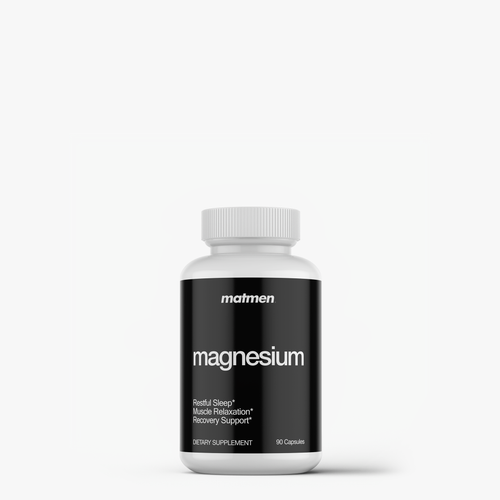
Magnesium. Hard training runs down magnesium, and it plays a direct role in muscle relaxation and sleep quality. Deeper sleep means better repair. Magnesium glycinate is the form worth taking at night, since it absorbs well and doesn't send you running to the bathroom.
Omega-3s. Research suggests the EPA and DHA in fish oil support a healthy inflammatory response after hard exercise. That matters because DOMS is partly an inflammation story. This is a daily habit play, not something you take once when you're already sore.
Turmeric and ginger. Both have been studied for supporting comfortable joints and muscles after exercise. A turmeric and ginger combo earns its spot during heavy training blocks, when everything aches a little by Thursday.
What about ice baths? Cold plunges blunt soreness in the moment, but some research suggests regularly icing right after training may dampen the adaptation you were training for. If you compete this weekend, cold helps you feel fresh. If you're building for the long term, save it for when you really need it.
When soreness is telling you something else
Normal DOMS is dull, spread across a muscle, worst around 24 to 48 hours after training, and it fades steadily. Pain that is sharp, located in a joint, present at rest, or getting worse after three days isn't DOMS. That's a signal to stop guessing and get it looked at.
Same goes for soreness that never leaves. If you're sore all week, every week, your body is losing the race between damage and repair. That's a volume and recovery problem, not a toughness problem. Scale back before your body scales you back.
Soreness is part of the deal in this sport. Handle the basics, be patient with the repair process, and it becomes background noise instead of the thing that decides whether you train.
This article is for informational purposes only and is not medical advice.